
A novel water additive increases voluntary water intake in healthy horses
Authors:
Kylie Yancey, BS; Diana Hassel, DVM, PhD, DACVS, DACVECC; Sangeeta Rao, BVSc, MVSc, PhD; Kathyrn A. Seabaugh, DVM, MS, DACVS, DACVSMR*
Department of Clinical Sciences, College of Veterinary Medicine and Biomedical Sciences, Colorado State University, Fort Collins, CO
*Corresponding author: Dr. Seabaugh (seabaugh@colostate.edu)
Abstract
Objective
To determine whether healthy horses would increase their voluntary water intake (VWI) when offered a novel water additive (NWA) compared to plain water (TAP) and water flavored with sweet feed, referred to as sweet tea (ST).
Methods
12 clinically healthy horses, aged 2 to 5 years old, were enrolled in the experimental crossover design. Four horses were assigned to each group for each of the 3 study weeks. The order that the horses were allocated to study groups was randomly assigned. All horses had access to 2 buckets filled to 16 L, one containing plain water (untreated bucket) and one containing TAP, ST, or NWA (study bucket). Bucket volume for both buckets was measured 3 times daily and refreshed at a minimum of once per day. Individual bucket volumes and total VWI (both buckets) were calculated daily. Manure production was documented twice daily. Each study week consisted of a 5-day assessment followed by a 1-week washout period.
Results
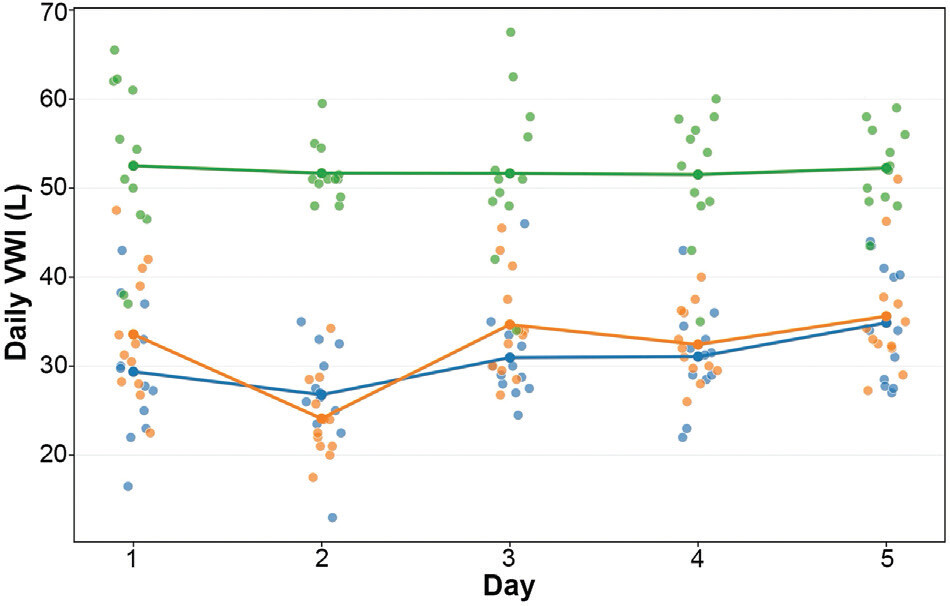
Horses drank significantly more water per day (52.0 ± 6.7 L) when assigned to the NWA group versus TAP (30.1 ± 6.2 L) and ST (32.0 ± 5.8 L). The number of fecal piles was significantly greater for NWA compared to ST on day 4 (6.8 ± 1.8 compared to 4.8 ± 1.4, respectively). The horses did not experience any adverse effects during the study.
Conclusions
Findings demonstrated that horses offered water containing NWA drank significantly more water compared to those offered TAP or ST.
Clinical Relevance
Healthy horses presented with NWA had a statistically significant increase in VWI when compared to TAP or ST.


